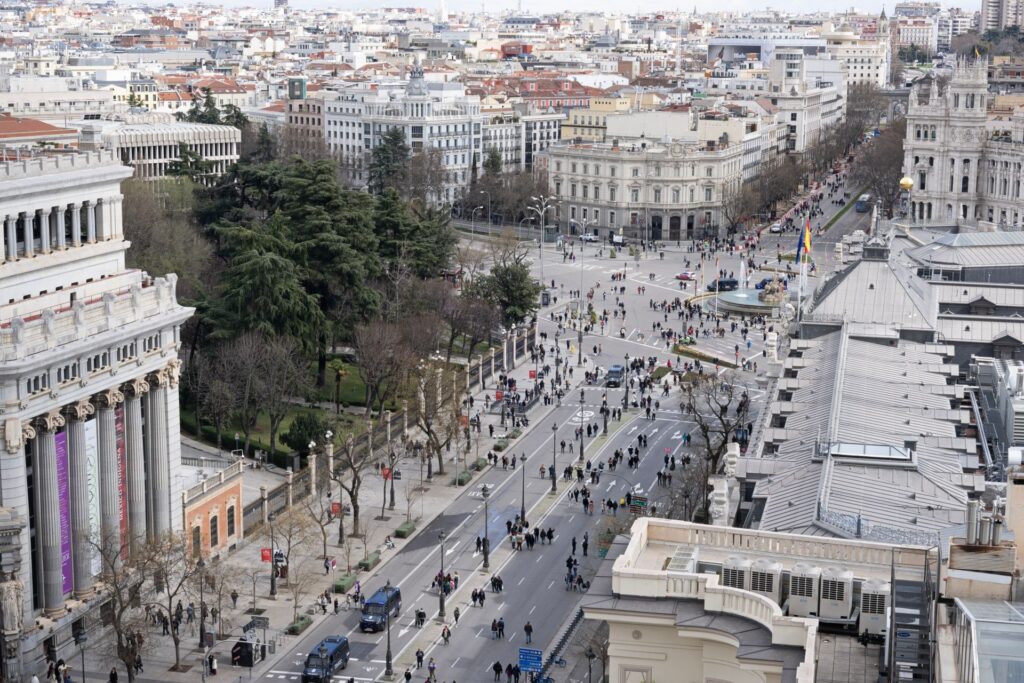
Madrid is Spain’s capital, and its centre is compact enough for groups to see many sights in a short stay. The top places to visit in Madrid include three famous museums, a royal palace, historic squares and a large park. As a result, one or two days already give a strong first impression.
First, this guide lists the main places and what makes each one worth a stop. Then it gives planning tips for groups. For a full itinerary, see our Madrid destination page.
The Prado, the Thyssen and the Reina Sofía
Three museums stand within walking distance of each other. The Prado opened to the public in November 1819, and Goya is the best-represented artist in its collection. Velázquez, El Greco, Rubens, Titian and Bosch also feature.
The Thyssen-Bornemisza Museum opened in 1992 and has more than 1,600 paintings. Moreover, it fills gaps in its two neighbours, with Italian primitives and Impressionists. The Reina Sofía covers modern and contemporary art, including Picasso and Dalí.
The Royal Palace and Plaza de Oriente
The Royal Palace has about 135,000 m² and 3,418 rooms. Construction began in the 1730s, after the old Alcázar burned down in 1734. Today, the palace is used mainly for state ceremonies. Plaza de Oriente lies right in front of it, so groups can combine both in one walk.
Almudena Cathedral
Almudena Cathedral stands opposite the Royal Palace. Builders laid its first stone in 1883, and Pope John Paul II consecrated it on 15 June 1993. Its exterior is baroque, while the interior is neo-Gothic. Besides, a neo-Romanesque crypt holds a 16th-century image of the Virgen de la Almudena.
Plaza Mayor
Builders completed Plaza Mayor in 1619, and it measures 129 m by 94 m. In addition, 237 balconies overlook the square. A Christmas market takes place here every year, and stamp and coin collectors meet on Sunday and holiday mornings.
Mercado de San Miguel
The market opened in 1916 and stands right next to Plaza Mayor. Its iron and glass building was inspired by Les Halles in Paris. Today, it sells gourmet tapas, Iberian ham, rice dishes, fish, cheese and wine. Therefore, it suits a tasting stop for a small group.
Puerta del Sol
A plaque on the ground marks Kilometre Zero, the point from which Spanish road distances are measured. The statue of the bear and the strawberry tree, the symbol of Madrid, also stands here. Besides, the square’s clock rings in the New Year with the Twelve Grapes tradition.
Gran Vía
Gran Vía is the central avenue that links the Sol area with Plaza de España. Theatres, shops and cafés line it, so it works well for an evening walk after dinner.
Retiro Park and the Paseo del Prado
UNESCO listed the Paseo del Prado and Buen Retiro as a World Heritage cultural landscape in July 2021. The site covers about 200 hectares, and the Retiro gardens take up about 120 of them. Moreover, it also includes the Royal Botanic Garden and the fountains of Cibeles, Neptune and Apollo. Groups can walk from the park to the museums in a few minutes.
Temple of Debod
This Egyptian temple comes from Nubia, near Aswan, and dates from the early 2nd century BC. Egypt donated it to Spain in 1968, in thanks for help with the temples of Abu Simbel. Madrid rebuilt it in 1970–1972, and it opened to the public in 1972. It stands in a park near the Royal Palace.
El Rastro and La Latina
El Rastro is Madrid’s open-air market, with up to 3,500 stalls. It runs on Sundays and public holidays, from 9 am to 3 pm. Therefore, plan it for a free morning. La Latina, next door, is a popular area for tapas.
The Santiago Bernabéu stadium
The stadium opened on 14 December 1947. After its recent renovation, it has about 83,186 seats and a retractable roof. The Tour Bernabéu and the club museum opened in 1999. Football fans in your group may enjoy a visit, and we can ask about private access.
Planning a group visit to Madrid
- Time. Two days cover the museums, the palace and the main squares. Add a third day for the market, the temple and the stadium.
- Book early. Museums and the palace need advance group bookings, so confirm entries before you travel.
- Sunday. Because El Rastro runs only on Sundays and holidays, plan around the day.
- Day trips. Add Toledo or Segovia for a longer stay.
We work only with the travel trade. We never sell to the public or approach your customers. To plan a group tour in Madrid, send us your group brief. We reply with a costed proposal within 24 to 48 hours.
Frequently asked questions
What are the top places to visit in Madrid?
The Prado, Thyssen-Bornemisza and Reina Sofía museums, the Royal Palace, Almudena Cathedral, Plaza Mayor, San Miguel market, Puerta del Sol, Gran Vía, Retiro Park, the Temple of Debod, El Rastro and the Santiago Bernabéu stadium.
When did the Prado open?
The Prado opened to the public in November 1819.
How big is the Royal Palace of Madrid?
The palace covers about 135,000 m² and has 3,418 rooms. It is used mainly for state ceremonies.
When is El Rastro market open?
El Rastro runs on Sundays and public holidays, from 9 am to 3 pm according to municipal rules. Stalls often close around 3 or 4 pm.
Is Retiro Park a UNESCO site?
Yes. UNESCO listed the Paseo del Prado and Buen Retiro as a World Heritage cultural landscape in July 2021.
Can groups visit the Santiago Bernabéu stadium?
The Tour Bernabéu and the club museum opened in 1999, and the stadium reopened after a major renovation. Ask us about group access and private visits for your dates.
Where is the Temple of Debod from?
It comes from Nubia, near Aswan in Egypt, and dates from the early 2nd century BC. Egypt donated it to Spain in 1968, and it opened in Madrid in 1972.
Can Iberinbound organise a Madrid sightseeing programme for my group?
Yes. We work only with the travel trade, and we arrange guides, coaches, museum entries and meals for groups from 8 travellers. We send a costed proposal within 24 to 48 hours.
Have another question about visiting Madrid with a group? Visit our full FAQ page or contact our team, and we will reply within 24 hours.
Data: Wikipedia (Museo del Prado, Thyssen-Bornemisza Museum, Royal Palace of Madrid, Almudena Cathedral, Plaza Mayor, Mercado de San Miguel, Puerta del Sol, Temple of Debod, El Rastro, Santiago Bernabéu Stadium), UNESCO World Heritage Centre and La Moncloa, 2026.