A group tour from Porto to Cape Fisterra links Northern Portugal with the Galician coast. On the way, groups see World Heritage towns, quiet fishing villages and the end of the Way of St James. Moreover, the route crosses the border between Portugal and Spain without fuss.
First, this guide lists the stops in order. Then it adds practical tips for tour operators who plan the route.
Porto to Cape Fisterra: stops in Northern Portugal
Porto
Porto is the second-largest city in Portugal. Its Historic Centre, the Luiz I Bridge and the Monastery of Serra do Pilar form a UNESCO World Heritage Site, which dates from 1996. In addition, the cellars of Vila Nova de Gaia once handled the export of port wine. Today, several of them offer guided tours and tastings.
Guimarães
Guimarães is often called the “birthplace of Portugal”, because Afonso Henriques was born there. UNESCO listed its historic centre in 2001. Besides, the town is known for Tortas de Guimarães, a half-moon pastry linked to its convent cooking.
Braga
The Romans founded Braga in 16 BCE and named it Bracara Augusta. Its cathedral dates back to the late 11th century, when Archbishop Peter began to rebuild it. Nearby, the sanctuary of Bom Jesus do Monte joined the UNESCO list in July 2019. Visitors can reach it on foot or by funicular.
Porto to Cape Fisterra: stops in Galicia
Tui and Valença
Tui stands on the Miño River, facing the Portuguese town of Valença. Two bridges join them. For example, the International Bridge opened in 1878, and a modern bridge dates from the 1990s. Because both countries belong to the Schengen area, the crossing normally has no formalities.
Tui also has a cathedral, built between the 11th and 13th centuries. In addition, a short version of the Portuguese Way of St James starts here, and it covers 116 km.
Cíes Islands
The Cíes Islands are three islands: Monteagudo, Do Faro and San Martiño. First, they became a Nature Reserve in 1980. Then, since 2002, they have been part of the Atlantic Islands of Galicia National Park. Also, Rodas beach, a sand strip about 1,200 m long, joins Do Faro and Monteagudo.
Boats run in summer from Vigo, Baiona and Cangas. However, landing needs an authorisation in high season. Groups can also join guided boat trips with local companies.
Pontevedra
Pontevedra lies at the head of the Ría de Pontevedra, in the Rías Baixas. It began to pedestrianise its old town in 1999. As a result, traffic in the old town and much of the centre is limited to residents and services.
In fact, the city has won international awards for its mobility model, including a UN-Habitat prize in 2014. Highlights include the Basilica of Santa María la Mayor, the Plaza de la Leña and the Church of the Pilgrim Virgin.
Combarro
Combarro lies only six kilometres from Pontevedra. Moreover, its old quarter is a Property of Cultural Interest. Three features stand out: the hórreos (raised granaries), the casas marineras (sea houses) and the stone crosses, called cruceiros.
Santiago de Compostela
Santiago de Compostela grew around the shrine of Saint James, now the Cathedral. It is also the destination of the Way of St James. Moreover, UNESCO listed its Old Town in 1985. For pilgrimage groups, see our pilgrimage trips.
Muros
Muros is an old harbour town on the way to the cape. Like most harbour towns on this coast, its economy is based on fishing. Therefore, it makes a calm stop between Santiago and the end of the route.
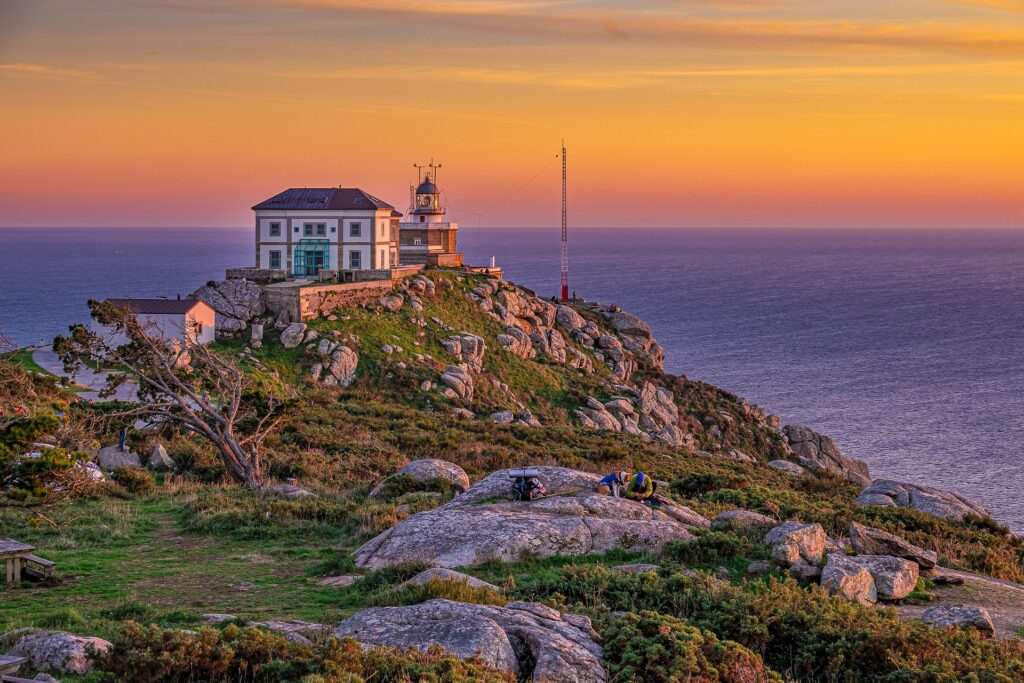
Cape Fisterra
Cape Fisterra is about 90 km from Santiago de Compostela. Its name comes from the Latin finis terrae, which means “end of the earth”. In addition, many pilgrims on the Way of St James finish their walk here. However, the origin of this pilgrimage is uncertain, and it may date from pre-Christian times. Some pilgrims go on to Muxía, a day’s walk away.
Planning a group tour from Porto to Cape Fisterra
- Cíes Islands. First, check the landing authorisation and boat times for your dates, because rules change by season.
- Border. Then, carry valid ID for every traveller, even if checks are rare.
- Pilgrimage groups. Besides, plan time in Santiago before the cape.
- Route length. Finally, choose the stops that fit your days, because the route is easy to shorten.
Iberinbound is an incoming DMC based in Barcelona. We work only with the travel trade. We never sell to the public or approach your customers. To plan this route, send us your group brief. We reply with a costed proposal within 24 to 48 hours.
Frequently asked questions
How far is Cape Fisterra from Santiago de Compostela?
About 90 km. Many Way of St James pilgrims continue to the cape after Santiago, and some go on to Muxía, a day’s walk away.
Do groups need a permit to visit the Cíes Islands?
Yes, in high season. Landing needs an authorisation, and boats run from Vigo, Baiona and Cangas, mostly in summer. Rules and dates change each year, so we check them for your group.
Is there a border check between Tui and Valença?
Usually not. Portugal and Spain are both in the Schengen area, so the crossing normally has no formalities. Travellers should still carry valid ID.
Which UNESCO sites are on the route?
The Historic Centre of Porto (1996), the Historic Centre of Guimarães (2001), Bom Jesus do Monte in Braga (2019) and the Old Town of Santiago de Compostela (1985).
Can the route include the Way of St James?
Yes. A short version of the Portuguese Way starts in Tui and covers 116 km. Groups can also visit Santiago de Compostela and finish at Cape Fisterra.
Can Iberinbound organise a Porto to Cape Fisterra tour for my group?
Yes. We arrange hotels, coaches, guides and boat trips for groups from 8 travellers, and send a costed proposal within 24 to 48 hours.
Have another question about group tours in Portugal and Galicia? Visit our full FAQ page or contact our team, and we will reply within 24 hours.
Data: Wikipedia (Porto, Guimarães, Braga, Tui, Pontevedra, Cíes Islands, Cape Finisterre), Spain.info and the Cíes reservation portal (cies.gal), 2026.